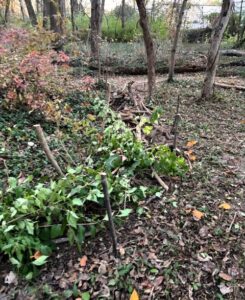
 Something new is shaping up in Ruth Woods. UCB Horticulturalist Jesse Gilbertson, staff, and volunteers have been hard at work on a brand new “dead hedge.” It’s in its earliest stages in our newest clearing in the Woods.
Or is it:
A. Woodland Fantastical Sculpture
B. Wildlife Habitat
C. Playground for Little People
D. Direct Deposit Container for Invasive Plant Debris
Correct Answer: All of the above.
So, what exactly is a “dead hedge?”
It is a containment system for branches and other yard waste. It is the simplest of systems. A dead hedge is a barrier constructed from cut branches, saplings, and foliage. It is constructed with upright standing wooden stakes, placed in two offset rows. The area between them is filled with prunings. Here, along the new path beside the River des Peres, our crew has been working on an untouched area full of invasives. Instead of hauling away mounds of honeysuckle branches, the cuttings can be woven into the new, and enlarging, dead hedge. Over time, this accumulation of branches will become habitat for wildlife and will teem with life. The wood will decay with the help of a variety of fungi. Insects can find a home which will attract birds and other small wildlife. There are lots of little spaces for protection. You know about wildlife habitat….we need more of that!
What if your gardening skills overlapped with some strong artistic skills? What if you didn’t want to hide your debris, but you wanted to show it off? What about something really large and really whimsical? What about a dead hedge winding along the new clearing that is 100’s of feet long?
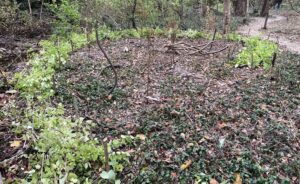
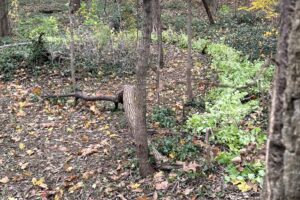
While Jesse has created woodland art for the humans, it is still wildlife habitat for the critters. As we remove the invasive shrub honeysuckle and wintercreeper from trees in overgrown areas, we leave behind a forest floor covered with wintercreeper scattered with mature and juvenile trees, a few native shrubs, and vines, and sometimes little else. But we can’t easily remove the wintercreeper on the forest floor without pretty thoroughly clearing the forest floor of other growth. So, we are removing some habitat as we remove the invasives. Some in the restoration community think that building a variety of wildlife habitats, such as a dead hedge, is akin to adding more baby trees and shrubs. It jumpstarts both the plant and wildlife ecological restoration
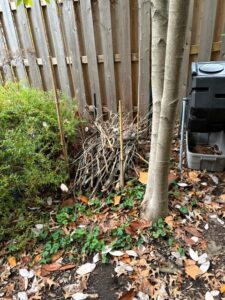 While we’re thinking big in the expansive Woods, you can utilize this same system in your own yards. I have some very generous sycamore trees, and this is where those branches go. I leave most of my plant stalks standing thru the winter for bird and insect habitat. But sometimes they fall over into a walkway, and they need to go. So here is a place for them to go, right in my own yard. It is in a corner of my yard behind some asters and next to some composting bins. I am keeping more and more of my yard waste to break down on my own property. Branches take a lot of time to tie up in bundles or break up into yard waste bags. I would rather use this system. I can pick up an armload of branches in the front yard and just walk them back to this area and plunk them in. Done. This equals yard waste sustainability. The fallen branches don’t have to equal trash being driven away in a big truck. Now they are being utilized as a resource. DO try this at home!
So, head over to the McKnight Trailhead (just southeast of the Olive intersection with McKnight).
https://maps.app.goo.gl/pgKpo8BWT8E6SGHr6
Walk past the yard waste processing area. Go over the bridge. Where the gravel trail divides, take the north branch. A short walk will take you to a new trail off to your left. It wanders more closely to the River des Peres. You will quickly see a large flat cleared area of the Woods. This is where the new dead hedge is taking shape. You can also stay on the gravel trail as it runs along the upper side of the clearing to get a different view.