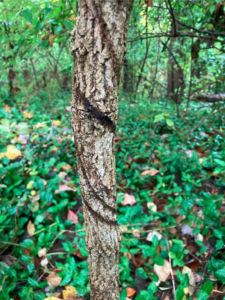
Japanese honeysuckle scarring by Kristin Soifer
I’m back to Ruth Park Woods invasives with this post, and this week’s focus is vine or Japanese honeysuckle Lonicera japonica. It smells lovely, tastes sweet (did you ever try sucking the nectar out of the flowers when you were young?), and can smother trees to death. It can also smother shrubs and large expanses of the forest floor. If it is on the trunk of a tree for long enough, it leaves a scar. The vine spirals around the trunk and does not expand as the tree grows. As the tree trunk grows larger, it pushes out around the honeysuckle vine. The vine can even kill trees by girdling them (cutting through the bark all the way around the tree, keeping water and nutrients from reaching the leaves). Once the vine reaches the tree’s branches, it spreads over the leaves, eventually hoarding all the sunlight the tree should get.
Why is it called “Japanese”?
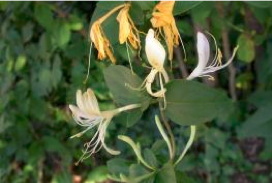
Japanese honeysuckle flowers courtesy Missouri Dept. of Conservation
Japanese honeysuckle is native to Japan. Although some invasives arrive by accident mixed in with other plant products or on people’s clothing, Japanese honeysuckle was brought to the U.S. on purpose in 1806 for use as an ornamental plant. Because it grows fast, it has also been used for erosion control—but it escaped! The Missouri climate is similar enough to the Japanese climate that it grows well here, and there are no Missouri insects, animals, or diseases that keep it from taking over.
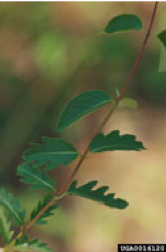
James H. Miller & Ted Bodner, Southern Weed Science Society, Bugwood.org, licensed under a Creative Commons Attribution 3.0 License
It’s tricky!
Like bush honeysuckle, Japanese honeysuckle leafs out before most Missouri native plants—it is actually semi-evergreen in the St. Louis area. This gives it a huge growing advantage every spring. It can also trick you into thinking that it is another plant entirely—it tricked me this spring. The early spring leaves on new shoots of Japanese honeysuckle do not look like the leaves that develop later. Instead of being simple oval leaves they are deeply lobed—think miniature oak leaves. Don’t be fooled—pull it out ASAP!
The moral of the story
Be careful what you plant in your garden! You can check this Missouri Botanical Garden website list of invasive plants to avoid—and remove—if they are already in your yard. If you love honeysuckle, coral honeysuckle (Lonicera sempervirens), and yellow honeysuckle (Lonicera flava) are great non-invasive, native choices.
Kristin Soifer is a volunteer and summer intern with U City in Bloom’s Ruth Park Woods restoration project, and she is also a graduate student with Project Dragonfly at Miami University in Oxford, Ohio and in conjunction with the Missouri Botanical Garden.