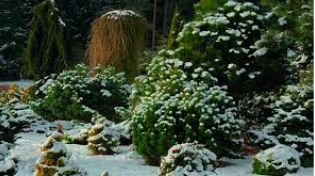
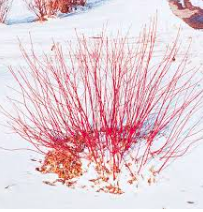
Winter can be grey, cold and dreary especially for gardeners who long for the lush growth and flowering plants of spring and summer. There is a way to fight against the idea that the winter garden is a boring dormant scene. There are so many characteristics of plants that really have their time to shine in the winter months. Trees and shrubs that have interesting bark, stems, buds, structure and fruit. Perennials that have seed heads and stems that create visual interest in a garden may feed or provide shelter for wildlife. Grasses/sedges give soft texture and movement. Of course we can not forget about evergreens, which give us color all year round. When you plan a garden or go for a walk outside on a sunny winter day consider what plants grab your attention and consider incorporating them into a garden.
There are so many examples of trees and shrubs that have interesting bark, stems, structure, and buds I will just name a few of my favorites.
Acer triflorum, Acer griseum, and Hydrangea quercifolia all have flaky bark that peel away from their stems/trunks and looks quite stunning. The hydrangea has the added bonus of dried flowers for even more winter interest.
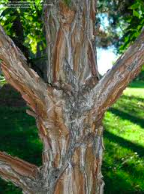
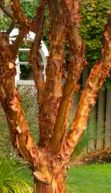
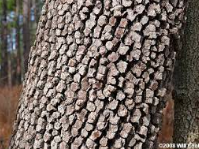
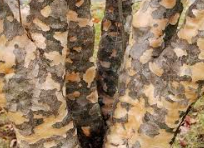
Cherry trees have shiny, sometimes cinnamon-colored bark that is very handsome. Cornus florida, our native dogwood has 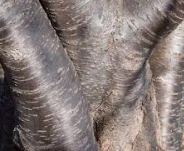 really cool blocky bark. Cornus kousa has a multi-colored, mottled look to its bark.
The structure of trees and shrubs is easier to see and appreciate during the winter. Deciduous trees’ and shrubs’ leafless forms stand out and look stunning in snow and ice (even though it can be damaging). I especially love multi-stem trees in winter like magnolias, serviceberries, Japanese maples, and witch hazels. Trees with zig-zag branches like locust, redbud, hackberry, and elm are visually interesting.
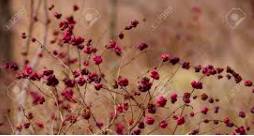
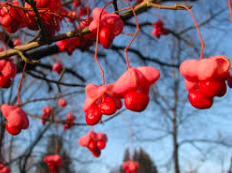
There are trees and shrubs that have buds that are unique like on some Magnolia who’s soft, fuzzy buds beg to be touched. There are trees and shrubs that hold on to fruits in winter which supply food for wildlife like: holly, crabapple, coralberry, hawthorn (there is one just east of the eastern entrance to Centennial Commons that is stunning), bayberry, viburnum, firethorn, chokeberry, cotoneaster, eastern wahoo, and sumac.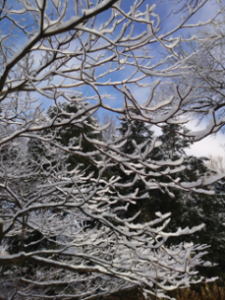
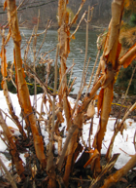
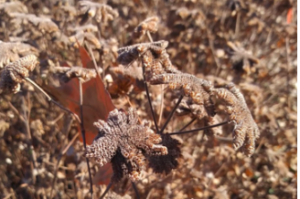
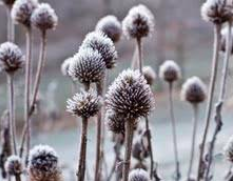
There are many herbaceous plants that are eye candy as well as provide food and shelter for critters in winter. I love mountain mint (pictured below, left). It holds up so well, looks unique, and smells nice. Other plants that provide winter interest are Monarda, Echinacea, Liatrus, Hibiscus, Artemisia, Bergenia, Heuchera, Rudbeckia, but really any plant whose structure, seeds, or spent flowers you like can be left up to enjoy.
There are many herbaceous plants that are eye candy as well as provide food and shelter for critters in winter. I love mountain mint (pictured below). It holds up so well, looks unique, and smells nice. Other plants that provide winter interest are Monarda, Echinacea, Liatrus, Hibiscus, Artemisia, Bergenia, Heuchera, Rudbeckia, but really any plant whose structure, seeds, or spent flowers you like can be left up to enjoy.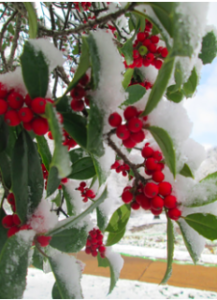
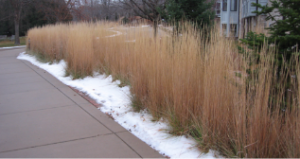
Grasses and grass-like plants like sedges provide so much beauty and movement to gardens. I love their texture. Mass planting of grasses and sedges gives me a feeling of serenity and calm for some reason. In the urban environment they do such a great job of softening buildings and hardscaping. Fine examples of such plantings in University City are the parking lots of Barbara Jordan and Pershing schools. Little bluestem is a native grass (pictured left) that is one of my favorites because of its color and generally stays upright as well.
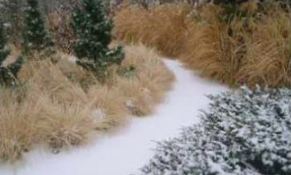 Evergreens are excellent year round additions to the garden. There are many options in size, habit, color, and texture. Any open spot you have in the garden there is probably an evergreen or near evergreen plant that will fit it.
Our thoughts may immediately jump to conifers when we hear evergreen, but there are perennials that have evergreen/near evergreen foliage as well. Heuchera, Bergenia, some Geranium, some ferns, Yucca, Helleborus, Ajuga, some Asarum, some Carex, Epimedium, Euphorbia just to name a few.
Evergreen trees and shrubs have so many design uses in a garden from anchoring a design, balancing weight, providing a specimen plant, carrying the eye upward or across a space, providing a backdrop for other plants to stand out against and on and on. Evergreen trees and shrubs also provide shelter and nesting opportunities for birds and other wildlife.
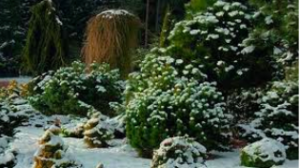 I hope I have opened up your minds to enjoy some of the winter interest out in both landscaped and natural spaces and consider the winter season when planting gardens.
Evergreens are excellent year round additions to the garden. There are many options in size, habit, color, and texture. Any open spot you have in the garden there is probably an evergreen or near evergreen plant that will fit it.
Our thoughts may immediately jump to conifers when we hear evergreen, but there are perennials that have evergreen/near evergreen foliage as well. Heuchera, Bergenia, some Geranium, some ferns, Yucca, Helleborus, Ajuga, some Asarum, some Carex, Epimedium, Euphorbia just to name a few.
Evergreen trees and shrubs have so many design uses in a garden from anchoring a design, balancing weight, providing a specimen plant, carrying the eye upward or across a space, providing a backdrop for other plants to stand out against and on and on. Evergreen trees and shrubs also provide shelter and nesting opportunities for birds and other wildlife.
Grasses and grass-like plants like sedges provide so much beauty and movement to gardens. I love their texture. Mass planting of grasses and sedges gives me a feeling of serenity and calm for some reason. In the urban environment they do such a great job of softening buildings and hardscaping. Fine examples of such plantings in University City are the parking lots of Barbara Jordan and Pershing schools. Little bluestem is a native grass (pictured below, left) that is one of my favorites because of its color and generally stays upright as well.
Evergreens are excellent year round additions to the garden. There are many options in size, habit, color, and texture. Any open spot you have in the garden there is probably an evergreen or near evergreen plant that will fit it.
Our thoughts may immediately jump to conifers when we hear evergreen, but there are perennials that have evergreen/near evergreen foliage as well. Heuchera, Bergenia, some Geranium, some ferns, Yucca, Helleborus, Ajuga, some Asarum, some Carex, Epimedium, Euphorbia just to name a few.
Evergreen trees and shrubs have so many design uses in a garden from anchoring a design, balancing weight, providing a specimen plant, carrying the eye upward or across a space, providing a backdrop for other plants to stand out against and on and on. Evergreen trees and shrubs also provide shelter and nesting opportunities for birds and other wildlife.