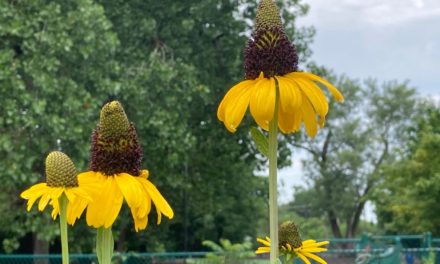
Phen…What? Phenology is one of the many -ologies — the study of something. In this case, it is the study of the timing of biological events that recur — usually on a seasonal basis, but I like to simply think of it as “let’s see what’s in bloom this week!” After cutting down bush honeysuckle and pulling wintercreeper this past Monday morning, I took a walk down the Ruth Park Woods trail to see what was in bloom, what was already producing fruit, and take some pictures.

Pokeweed flowers
Pokeweed (Phytolacca americana) is poisonous to humans, but birds enjoy its berries and disperse the seeds, which can survive in the ground for more than 40 years and still sprout. Although it is often considered a nuisance, scientists are studying it for antiviral and antitumor properties, and artisans who use native plants for dye find that its berries produce a lovely fuschia shade. Right now, its tiny, delicate flowers are the main attraction.

Tall bellflower
Tall bellflower lives up to its name as it can grow up to six feet tall. Other than being lovely, its claim to fame is that botanists can’t agree on whether it should be called Campanulastrum americanum or Campanula americana. It grows as well in gardens as in wooded areas, and is most often pollinated by bumblebees.

Green dragon leaf

Green dragon seed cluster
Green dragon (Arisaema dracontium)
Although the Missouri Department of Conservation website says that they are somewhat uncommon, there are a number of green dragons in Ruth Park Woods. Don’t worry, though, they are quite tame ;-). They are a relative of Jack-in-the-pulpit, and the relationship is easy to see when viewing the seed cluster which looks very similar in both species. That amazing swirl is a single leaf which can have as many as 15 leaflets, and the green seed cluster turns bright red in the fall.
Sedges are hard to tell apart, but this one appears to be straw-colored flatsedge or false nutsedge (Cyperus strigosus). It can get fairly tall — a bit over two feet, and it often grows in damp, disturbed places, in this case, along the trail by the yard waste bag recycling center. Its great texture makes it stand out from the crowd.
The next time you walk the Ruth Park Woods trail, consider making it a phenology walk; you might be amazed at what you find!

Straw-colored flatsedge
Sedges are hard to tell apart, but this one appears to be straw-colored flatsedge or false nutsedge (Cyperus strigosus). It can get fairly tall — a bit over two feet, and it often grows in damp, disturbed places, in this case, along the trail by the yard waste bag recycling center. Its great texture makes it stand out from the crowd.
The next time you walk the Ruth Park Woods trail, consider making it a phenology walk; you might be amazed at what you find!
Straw-colored flatsedge
Straw-colored flatsedge
Sedges are hard to tell apart, but this one appears to be straw-colored flatsedge or false nutsedge (Cyperus strigosus). It can get fairly tall — a bit over two feet, and it often grows in damp, disturbed places, in this case, along the trail by the yard waste bag recycling center. Its great texture makes it stand out from the crowd.
The next time you walk the Ruth Park Woods trail, consider making it a phenology walk; you might be amazed at what you find!
Kristin Soifer is a volunteer and summer intern with U City in Bloom’s Ruth Park Woods restoration project, and she is also a graduate student with Project Dragonfly at Miami University in Oxford, Ohio and in conjunction with the Missouri Botanical Garden.